
Order Details
| RBE No. | Not mentioned in the letter (the letter refers to RBE No. 61/2026 |
| Letter No. | File No. PC-VII/2026/HRMS/25 |
| Date | 06.10.2026 |
| Issued by | Railway Board, Ministry of Railways (Joint Director, Pay Commission & HRMS) |
| Subject | Circulation of process flow of revised Service Based Request Transfer (SBRT) module of HRMS |
| Effective from | 22.09.2026 (date from which the revised SBRT has been operationalised, as stated in the letter) |
Summary / Introduction
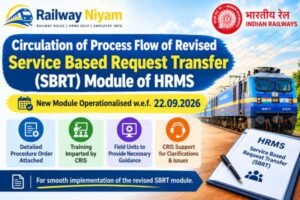
This letter is the follow-up to Board’s letter RBE No. 61/2026, which introduced a priority own request transfer scheme for non-gazetted employees with more than 20 years of regular service. Based on that policy, CRIS has modified the Service Based Request Transfer (SBRT) module of HRMS, and it has been operationalised from 22.09.2026. CRIS has already trained the concerned officials of field units on the new module.
The letter attaches a detailed Procedural Order for SBRT. It explains the monthly vacancy calculation and allotment on the 1st of every month, how employee applications flow through the system, how blocked applications are reviewed, and the validations built into the system. Field units can take CRIS’s help for any problem and are asked to guide employees in applying through the revised SBRT.
Key Highlights
- SBRT has been modified by CRIS as per RBE No. 61/2026 and operationalised from 22.09.2026.
- Vacancy calculation and allotment run as a monthly cycle on the 1st of every month.
- Applications are ranked in ascending order of Date of Appointment (DoA). Ties are broken by Date of Birth (older employee first), then by application timestamp.
- The latest valid DoA in the HRMS Employee Master is used if the DoA is corrected later, and a history of changes is kept for audit.
- Vacancy is reduced for existing commitments (valid NoCs for IRRT/IDRT, approved change of category, mutual transfer cases and earlier SBRT allotments awaiting joining) and for vacancy blocked for Compassionate Ground appointments and RRB/RRC candidates.
- Applications not allotted a vacancy stay active and are considered again in the next cycle. Once vacancy is allotted, the applicant cannot withdraw the application.
- After allotment, the supervisor-level release has to be processed, with escalation if the process is not started or completed within 15 days each.
- If D&AR/Vigilance clearance is not available, the application is blocked for six months with the approval of the Competent Authority, and the allotted vacancy is released.
- Rejection applies where the employee lacks the prescribed educational qualification, medical fitness or regular service of 20 years.
- Blocked applications and employees awaiting release are reviewed every month by the DRM/CWM/HOD at HQ.
- The system links NoC issue (IRRT/IDRT) and Change of Category approval with vacancy in the relevant Incoming Priority Group.
- Mutual Transfer Module 1.0 is closed. Pending IRMT 1.0 applications are being ported to IRMT 2.0.
- Transfers from PUs/Workshops to open line, and from one PU/Workshop to another, are permitted.
Cadre Codes where transfer across Departments is permitted (against the same Cadre Code):
| Sl. No. | Category | Cadre Code |
|---|---|---|
| 1 | Ministerial | 267000 |
| 2 | Motor Driver | 271000 |
| 3 | Cook | 268000 |
| 4 | Stenographers | 273000 |
| 5 | Typist | 277000 |
| 6 | Psycho Technical Cell | 312000 |
| 7 | Cook | 385000 |
Original Text of RBE
GOVERNMENT OF INDIA (भारत सरकार)
MINISTRY OF RAILWAYS (रेल मंत्रालय)
RAILWAY BOARD (रेलवे बोर्ड)
File No. PC-VII/2026/HRMS/25 New Delhi,
Dated : As signed
The General Manager,
All Railways (as per list)
Sub: Circulation of process flow of revised Service Based Request Transfer (SBRT) module of HRMS
Sir,
Based on the service transfer policy notified by Board’s letter no RBE 61/2026, the Service Based Request Transfer (SBRT) has been modified by CRIS and has been operationalised w.e.f. 22.09.2026.
2. The detailed training session with regard to the new module has been imparted by CRIS to the concerned officials of various field units dealing with HRMS, prior to launch of module.
3. The Detailed procedure order for implementation of SBRT is attached herewith and the same may be utilized for operationalization of the module. In case of any clarification or problems being faced by field units regarding operationalization of the module, the field units may take the assistance of CRIS for resolving the same. The field units are also advised to extend necessary help to the concerned employees for applying through the revised SBRT by providing necessary guidance.
4. This is issuance with the approval of Competent Authority.
DA: As above
Digitally signed by
Jaya Kumar G
Date: 06-10-2026
09:42:06
(Jaya Kumar G)
Joint Director Pay Commission & HRMS
Railway Board
Ph. No. 011-47845125
e-mail : jaya.kumarg@gov.in
Procedural Order for Implementation of SBRT
In pursuance of the Transfer Policy for prioritising own-request transfer of non-gazetted Railway employees having more than 20 years of regular service, notified vide RBE No. 61/2026, the following procedure shall be followed for processing applications, determination of priority, calculation and allotment of vacancies, processing of release cases, and disposal of cases involving D&AR/Vigilance issues.
The procedure shall be implemented through a monthly cycle, with vacancy calculation and allotment being undertaken on the 1st day of every month, in accordance with the provisions contained herein and extant instructions on the subject.
1. PROCESS FOR VACANCY CALCULATION AND ALLOTMENT ON THE 1ST OF EVERY MONTH
Step 1: Unblocking of Applications on Expiry of Block Period
At the commencement of the monthly allotment cycle, all applications which have been blocked on account of D&AR/Vigilance issues shall be examined.
Where the approved period of blockage has expired as on the 1st day of the month, the application shall be unblocked and shall become eligible for consideration.
Where the period of blockage has been extended by the Competent Authority, the application shall continue to remain blocked for the extended period.
Step 2: Re-assignment of Priority
All active applications pertaining to the concerned Incoming Priority Group and submitted up to 24:00 hours of the last calendar day of the preceding month shall be considered for the monthly cycle.
Applications which have been withdrawn, rejected, blocked or cases where the employee has joined the destination unit, shall be treated as inactive and shall not be considered for allotment.
All active applications within an Incoming Priority Group shall be arranged in ascending order of Date of Appointment (DoA) and priority shall accordingly be assigned/re-assigned for the monthly cycle.
The employee particulars (Date of Appointment) available at the time of submission of the application shall be captured for processing purposes. In case the Date of Appointment recorded at the time of submission is subsequently corrected in the Employee Master of HRMS, the latest valid Date of Appointment available in the Employee Master shall be taken into account for determination of service length and priority, as applicable.
A history of changes made in the Date of Appointment shall be maintained for audit and verification purposes.
Where two or more employees have the same Date of Appointment and have applied for the same Incoming Priority Group, priority shall be determined based on Date of Birth (DOB), with the older employee being placed higher in priority. If the DOB is also the same, priority shall be determined based on the application timestamp, with the employee who submitted the application earlier being placed higher in priority.
Step 3: Procedure for Calculation of Vacancy
The existing procedure for calculation of vacancy followed in the Indent Management system shall be adopted for determining vacancies under this process.
The Cadre Code, Cadre levels/grades and corresponding intake types have been defined in HRMS System. Higher-grade vacancies under PQ and LDCE quota shall be downgraded and distributed proportionately amongst the applicable intake types of the current grade, in accordance with the procedure followed in Indent Management.
At the DR quota level, the DR vacancy available in the concerned grade shall be combined with the proportionate higher-grade vacancy attributable to the DR quota of that grade/level.
Accordingly, the total vacancy available for each cadre group (Cadre Level ID) under the DR quota shall be determined.
Where multiple seniority groups, i.e. multiple Cadre IDs, correspond to a common Incoming Priority Group within a unit, the DR quota vacancy determined individually for each Cadre Level ID shall be aggregated for the concerned Incoming Priority Group.
Step 4: Monthly Vacancy Position
The vacancy position determined in accordance with Step 3 shall be calculated as on the 1st day of every month and shall form the basis for the allotment process for the concerned monthly cycle.
Step 5: Adjustment against Existing Commitments
Against the vacancy determined under Step 4, the following shall be taken into account:
- Applications for which NoC has been issued and remains valid for IRRT/IDRT;
- Applications for which change of category has been approved;
- Employees released by the APO of the originating unit on account of Mutual Transfer and yet to join destination unit; and
- SBRT applications in respect of which vacancy was allotted in a previous cycle but the employee has not yet joined the destination unit.
- Applications for which employee has been released from parent unit and yet to join destination unit where after release of employee his /her NOC has expired.
The vacancy corresponding to the above cases shall be deducted from the vacancy determined under Step 4 for the concerned Incoming Priority Group.
Step 6: Deduction of Vacancy Blocked by Destination Unit
The destination unit shall identify and block vacancies required for Compassionate Ground appointments and RRB/RRC candidates on hand, as applicable.
Such vacancy shall be blocked afresh for each monthly cycle.
The vacancy so blocked shall be deducted from the vacancy available after Step 5.
Step 7: Vacancy Available for Current Cycle
The balance vacancy after giving effect to Steps 6 shall be treated as the vacancy available for allotment to the concerned Incoming Priority Group for the current monthly cycle.
Step 8: Priority-wise Allotment
Applications shall be considered for allotment in the order of priority determined under Step 2.
Vacancy shall be allotted to an eligible application, subject to the application not being blocked and subject to the vacancy not having already been reserved against the application in a previous cycle.
The allotment process shall continue until:
a. the available vacancy is exhausted; or
b. all eligible applications available for allotment have been considered.
Where vacancy is allotted, the necessary transfer order/process shall be initiated for the concerned Incoming Priority Group by the system.
Step 9: Utilisation of Balance Vacancy
Any balance vacancy remaining after completion of the allotment process may be utilised for issue of NoC for IRRT/IDRT, issue of NoC out of turn for IRRT/IDRT, change of category.
Step 10: Monthly Recurrence
The above process shall be repeated on the 1st day of every month.
Dynamic Nature of Balance Vacancy indicated in Step 9.
The vacancy position shall remain dynamic during the month. Where an SBRT application is subsequently blocked on account of D&AR/Vigilance issues, the corresponding vacancy shall be released. Similarly, where an SBRT application is rejected on account of non-fulfilment of prescribed conditions, such as educational qualification, medical fitness, service length, etc., the corresponding vacancy shall be released.
Conversely, the vacancy position shall stand reduced upon grant or extension of NoC, approval of change of category.
2. PROCESS FLOW FOR APPLICATIONS SUBMITTED BY EMPLOYEES
Step 1: Submission of Application
An eligible employee may submit an application under the scheme for transfer to any eligible unit, including a unit within the same Zone or outside the Zone, as permissible under the policy.
The application shall be submitted against the appropriate Incoming Priority Group.
Step 2: Status of Application
Upon submission, the application shall be accorded the status of “Application Submitted”.
The application shall be pooled with all other active applications pertaining to the concerned Incoming Priority Group, including applications originating from units distributed across Indian Railways.
Step 3: Assignment of Priority
On the 1st day of the following month, the application shall be considered for priority assignment in accordance with the process elaborated in step 2 of “PROCESS FOR VACANCY CALCULATION AND ALLOTMENT ON THE 1ST OF EVERY MONTH”.
Step 4: Vacancy Calculation and Allotment
The vacancy shall be calculated in accordance with the procedure prescribed in Section 1(“PROCESS FOR VACANCY CALCULATION AND ALLOTMENT ON THE 1ST OF EVERY MONTH”) and the allotment process shall thereafter be undertaken on the basis of priority.
Step 5: Application for which Vacancy is not Allotted
Where vacancy is not allotted to an application in a particular cycle, the application shall remain active and shall be considered in the subsequent monthly cycle.
Such application shall be pooled with all other active applications, including eligible applications submitted before the commencement of the next cycle, and priority shall be determined afresh in accordance with the prescribed procedure.
Where an employee withdraws the application before allotment, the application shall become inactive and shall not be considered in subsequent cycles.
Step 6: Application for which Vacancy is Allotted -Processing for Release after Allotment
Workflow1: Once vacancy has been allotted, the application shall be processed for release from the originating unit.
The official to whom the case is to be routed shall be identified in the following order:
- Mapped Supervisor;
- Leave Supervisor, where the employee’s leave application is being processed through such supervisor;
- Leave Clerk mapped to the employee; and
- Default Leave Clerk of the unit.
Where the workflow/e-file is received by the Leave Supervisor, Leave Clerk or Default Leave Clerk, the concerned official shall forward the same to the appropriate supervisor for further processing.
Workflow2: Once vacancy has been allotted, the application shall be processed for D&AR / Vigilance clearance and eligibility of employee parallelly along with Supervisor release process in originating unit.
The official to whom the case is to be routed shall be identified in the following order:
- Mapped DC (Dealing Clerk);
- Default Dealing Clerk of the unit.
Where the workflow/e-file is received by the Dealing Clerk or Default Dealing Clerk, the concerned official shall forward the same to the appropriate authority for further processing.
Step 7: Supervisor-level Processing and Escalation
The concerned supervisor shall process the case and obtain the approval of the JAG Officer/Branch Officer, as applicable.
Where the supervisor does not initiate the process within 15 days, the case shall be notified to the mapped JAG Officer/Branch Officer. Where the approval of JAG Officer /Branch Officer has been obtained and yet employee is not released by supervisor, concerned officer will be notified.
Where the release process is not completed within the subsequent 15 days, the case shall be escalated in accordance with the prescribed procedure. The APO may escalate the issue of the release of the employee to the level of DRM/CWM/HOD at HQ, as applicable.
Step 8: Verification and Release by APO
The Dealing Clerk shall initiate the case and connect the relevant D&AR and Vigilance status/cases along with other requisite particulars.
The APO shall examine the case with reference to:
- D&AR status;
- Vigilance status;
- Educational qualification;
- Medical fitness;
- Service requirements; and
- Other prescribed eligibility conditions if any.
Where all prescribed conditions are fulfilled, the case shall be approved for release and the employee shall be released from the originating unit.
Where the employee does not fulfil the prescribed educational qualification or medical fitness requirements or regular service of 20 years, the case shall be processed for rejection and approval of the DRM/CWM/HOD at HQ shall be obtained, wherever required.
Where the requisite D&AR/Vigilance clearance is not available, the application shall be blocked for a period of six months, with the approval of the Competent Authority.
According to the decision in current workflow, following action will be taken.
i) Case 1: Employee fulfils the prescribed conditions of transfer and have requisite D&AR and Vigilance clearances. In this case, Supervisor can release the employee by issuing release memo for reporting to APO of source unit. Thereafter APO will release the employee from the originating unit to report at destination unit.
ii) Case 2: Employee does not fulfil the prescribed conditions of transfer, his/her application is rejected. In this case, Workflow / process of release will be terminated. Allotted vacancy will be released immediately. His /her application will be inactive.
iii) Case 3: Employee fulfils the prescribed conditions of transfer but does not have requisite D&AR and Vigilance clearances. In this case, his/her application is blocked for 6 months. In this case, Workflow / process of release will be terminated. Allotted vacancy will be released immediately. His /her application will be in blocked state.
Step 9: Joining at Destination Unit
After release from the originating unit, the employee shall report to the destination unit.
The appropriate Cadre ID/Level ID linked to the concerned Incoming Priority Group shall be determined at the destination unit and the posting order shall be issued accordingly.
The employee shall thereafter report to the concerned supervisor and assume duty.
Restriction on Withdrawal
Once vacancy has been allotted to an application, the applicant shall not be permitted to withdraw the application.
Similarly, where an application has been blocked on account of D&AR/Vigilance issues, the applicant shall not be permitted to withdraw the application during the period of blockage.
3. PROCESS FLOW FOR UNBLOCKING / EXTENDING THE PERIOD OF BLOCKAGE OF A BLOCKED APPLICATION
Step 1: Initiation of Proposal by Dealing Clerk
The Dealing Clerk (DC) shall initiate the proposal for review of blocked applications.
The DC may select an individual blocked application or multiple blocked applications for inclusion in a single proposal.
The DC shall connect the latest D&AR and Vigilance status in respect of all applications included in the proposal and record appropriate remarks.
The proposal/e-file/workflow shall thereafter be forwarded to the concerned authorities through the prescribed channel.
Step 2: Examination by APO
The concerned APO shall examine and verify the proposal, including the D&AR and Vigilance status of the employees concerned.
After examination, the APO shall endorse the proposal to the DRM/CWM/HOD at HQ, as applicable, through the prescribed chain of officials for consideration and decision by the Competent Authority.
Step 3: Decision by Competent Authority
The Competent Authority shall examine the case with reference to the latest D&AR and Vigilance status and may take either of the following decisions:
(a) Unblocking of Application:
Where the Competent Authority considers that the application may be unblocked, the application shall be unblocked and shall become eligible for further processing in subsequent cycle.
(b) Extension of Block Period:
Where the Competent Authority considers that the circumstances warrant continuation of the blockage, the period of blockage may be extended for such period as may be decided by the Competent Authority.
The decision regarding unblocking or extension of the block period shall be recorded against the concerned application.
4. PROCESS FLOW FOR MONTHLY REVIEW OF BLOCKED APPLICATIONS AND EMPLOYEES AWAITING RELEASE
Step 1: Initiation of Monthly Review Proposal
The Dealing Clerk (DC) shall initiate the monthly review proposal.
The system shall automatically compile/provide the details of:
- Applications currently under blockage; and
- Employees awaiting release from the originating unit;
The DC shall verify the information and place the relevant cases before the concerned APO for further examination.
Step 2: Examination by APO
The concerned APO shall examine the cases included in the monthly review and verify the current status of each case. After examination, the APO shall endorse the proposal to the DRM/CWM/HOD at HQ, as applicable, through the prescribed chain of officials for consideration and decision.
Step 3: Review and Direction by Competent Authority
The Competent Authority shall review the cases placed before it and may issue appropriate directions for
- Early release of employees awaiting release;
- Unblocking of applications where considered appropriate;
5.. PROCESS FLOW FORBLOCKING THE VACANCY FROM NEXT MONTH FOR CGA/RRB /RRC CANDIDATES
Step 1: Initiation of Proposal
The Dealing Clerk (DC) shall initiate the proposal.
The system shall automatically provide the details of vacancy of current month against each Incoming Priority Group:
The DC shall indicate number of vacancies to be blocked against CGA /RRB /RRC papers on hand and place the relevant cases before the concerned APO for further examination.
Step 2: Examination by APO
The concerned APO shall examine the cases included in the proposal and verify the vacancy to be deducted from next month cycle for each case. After examination, the APO shall endorse the proposal to the Sr. DPO / Dy CPO, as applicable, through the prescribed chain of officials for consideration and decision.
Step 3: Review and Direction by Competent Authority
The Competent Authority shall review the cases placed before it and edit / confirm the number of vacancies to be blocked on account of pending CGA/RRB /RRC papers on hand.
The above process of blocking of vacancy should be reviewed and carried out before 1st of every month if units want to block the vacancy since SBRT system will reset the blocked vacancy for each incoming priority group every month.
Following important rules/validations have also been incorporated in implementation of SBRT
A. Linking of NoC Processes with Vacancy in the Incoming Priority Group
With necessary SBRT changes, the issue of NoC in all the transfer related processes such as IRRT, IDRT shall be linked with the availability of vacancy in the relevant Incoming Priority Group. The following provisions shall accordingly be incorporated in the system:
i. If no vacancy is available in the relevant Incoming Priority Group, the Destination Unit shall not be permitted to:
- issue NoC under IRRT/IDRT;
- issue NoC on Out-of-Turn basis under IRRT/IDRT; or
- extend an expired NoC under IRRT/IDRT.
ii. In case of extension of NoC, the system permits submission and processing of the request for extension before expiry of the existing NoC.
Where extension of NoC is approved by the Destination Unit within the validity period of the existing NoC, the vacancy already blocked against the valid NoC shall continue to remain blocked. Accordingly, the system shall not carry out a fresh vacancy check for the same Incoming Priority Group at the time of approval of such extension.
iii. The available vacancy under DR Quota for concerned Incoming Priority Group, wherever applicable, shall be checked by the system at the time of approval of the request.
B. Linking of Change of Category with Vacancy
With SBRT operationalised, approval of Change of Category by the Competent Authority shall be permitted only where vacancy is available in the relevant Incoming Priority Group corresponding to the category to which the employee is seeking transfer/change of category. Accordingly:
i. The system shall identify the relevant Incoming Priority Group and category against which the Change of Category is being sought.
ii. Availability of vacancy in the relevant Incoming Priority Group shall be checked by the system before approval by the Competent Authority.
iii. Where no vacancy is available in the relevant Incoming Priority Group, the Competent Authority shall not be permitted to approve the Change of Category request.
iv. The available vacancy under DR Quota for concerned Incoming Priority Group, wherever applicable, shall be checked by the system at the time of approval of the request.
C. Mutual Transfer Module 1.0 and Vacancy Accountability
In the existing Mutual Transfer Module 1.0, there is no provision for maintaining and processing transfers based on Cadre Code. The existing system operates primarily on the basis of designation. Consequently, vacancy accountability at the level of the Incoming Priority Group cannot be maintained under the existing module.
In view of the above, Mutual Transfer Module 1.0 is closed before implementation of Transfer process under RBE 61/2026. Necessary data of pending IRMT 1.0 applications are being ported to IRMT 2.0 at initial stage of certification for necessary processing through all stages, as the IRMT 2.0 process has been separately designed within UDIT.
D. Transfer Across Departments in Common Cadre Codes
Employees belonging to the following Cadre Codes are permitted to submit applications for transfer across Departments, provided the transfer is against the same Cadre Code:
| Sl. No. | Category | Cadre Code |
|---|---|---|
| 1 | Ministerial | 267000 |
| 2 | Motor Driver | 271000 |
| 3 | Cook | 268000 |
| 4 | Stenographers | 273000 |
| 5 | Typist | 277000 |
| 6 | Psycho Technical Cell | 312000 |
| 7 | Cook | 385000 |
E. Loco Running Staff Created under Different Departments/Cadre Codes
Transfer from one Loco Running cadre to another Loco Running cadre i.e. between Cadre Codes 218000 and 290000 is permitted under SBRT.
F. Option to Apply to the Recruitment Grade
An employee is permitted to apply for transfer on reversion to the post in which he was initially recruited as a specific exception to the general restriction on change of Department/Cadre Code under RBE 61/2026.
G. Transfers from PUs/Workshops
Transfers from PUs/Workshops to open line and from one PU/Workshop to another are permitted as such transfers are not specifically barred under RBE 61/2026.
Download Link
[Download Railway Board Letter No. PC-VII/2026/HRMS/25 (PDF)]
Eligibility
As stated in the letter and the attached Procedural Order:
- Who: An eligible employee under the scheme notified by RBE No. 61/2026 (non-gazetted Railway employees having more than 20 years of regular service).
- Where to apply: To any eligible unit, within the same Zone or outside the Zone, against the appropriate Incoming Priority Group.
- Conditions checked by the APO: D&AR status, Vigilance status, educational qualification, medical fitness, service requirements (including regular service of 20 years) and other prescribed eligibility conditions, if any.
- Selection method: Monthly allotment on the 1st of every month, in ascending order of Date of Appointment. Ties are decided by Date of Birth (older first) and then by application timestamp. Only applications submitted up to 24:00 hours of the last calendar day of the preceding month are considered in that cycle.
- Allotment is subject to: The application not being blocked, and vacancy being available in the Incoming Priority Group after the deductions described in the Procedural Order.
- Across Departments: Allowed only for the Cadre Codes listed in Para D, and against the same Cadre Code. Applying for reversion to the post of initial recruitment is also permitted.
Our Opinion
This section is our own reading of the RBE and is not part of the official order.
- For employees: The Procedural Order makes the monthly cycle clear. Apply on HRMS, wait for the 1st of the next month for priority, and stay in the pool if no vacancy is allotted. Since the latest valid Date of Appointment in the Employee Master decides priority, employees should check that their DoA is correctly recorded. Withdrawal is not allowed once vacancy is allotted or while an application is blocked.
- What is unclear or not stated: The letter has no RBE number of its own, and it has no Hindi version. It ranks applications by Date of Appointment, while RBE No. 61/2026 speaks of years of regular service, and the letter does not explain how the two relate. It also does not explain what an “Incoming Priority Group” means, or who the “Competent Authority” is in each case.
- Release timelines: The letter gives 15-day stages for supervisor-level processing and escalation, but it does not say how these fit with the 15-day physical relieving period in RBE No. 61/2026.
- What Zonal Railways still need to do: Use the Procedural Order to run the module, seek CRIS’s help where problems arise, and guide employees in applying. Dealing Clerks and APOs need to carry out the monthly review of blocked cases and employees awaiting release. Units that want to block vacancy for CGA/RRB/RRC candidates must do so before the 1st of every month, as the system resets the blocked vacancy every month.
FAQ
Q1. From when is the revised SBRT module operational?
The letter states that the revised SBRT has been operationalised w.e.f. 22.09.2026.
Q2. How is priority decided among applicants?
Active applications in an Incoming Priority Group are arranged in ascending order of Date of Appointment. If the DoA is the same, the older employee (by Date of Birth) gets higher priority, and if that is also the same, the earlier application timestamp decides.
Q3. What happens if an applicant has no D&AR/Vigilance clearance?
The application is blocked for six months with the approval of the Competent Authority, the allotted vacancy is released, and the release process is terminated. Blocked cases are reviewed every month.
Q4. Can an employee withdraw the application after vacancy is allotted?
No. Once vacancy is allotted, the applicant cannot withdraw the application. Withdrawal is also not allowed during a period of blockage.
Disclaimer: This post is for information only. The “Our Opinion” and FAQ sections are our own explanation of the RBE. Readers should refer to the official Railway Board letter and their Zonal Railway’s orders for authentic reference.
Tags: SBRT, Service Based Request Transfer, SBRT Module HRMS, RBE No. 61/2026, Own Request Transfer, 20 Years Regular Service, HRMS, CRIS, Procedural Order, Incoming Priority Group, D&AR Vigilance, PC-VII/2026/HRMS/25, Non-Gazetted Employees, Railway Board, IRMT 2.0, NoC IRRT IDRT